
A Business Central Implementation Guide for UK Businesses
A practical Business Central implementation guide for UK businesses: the phases, realistic timelines, the decisions that matter most, and how to prepare.
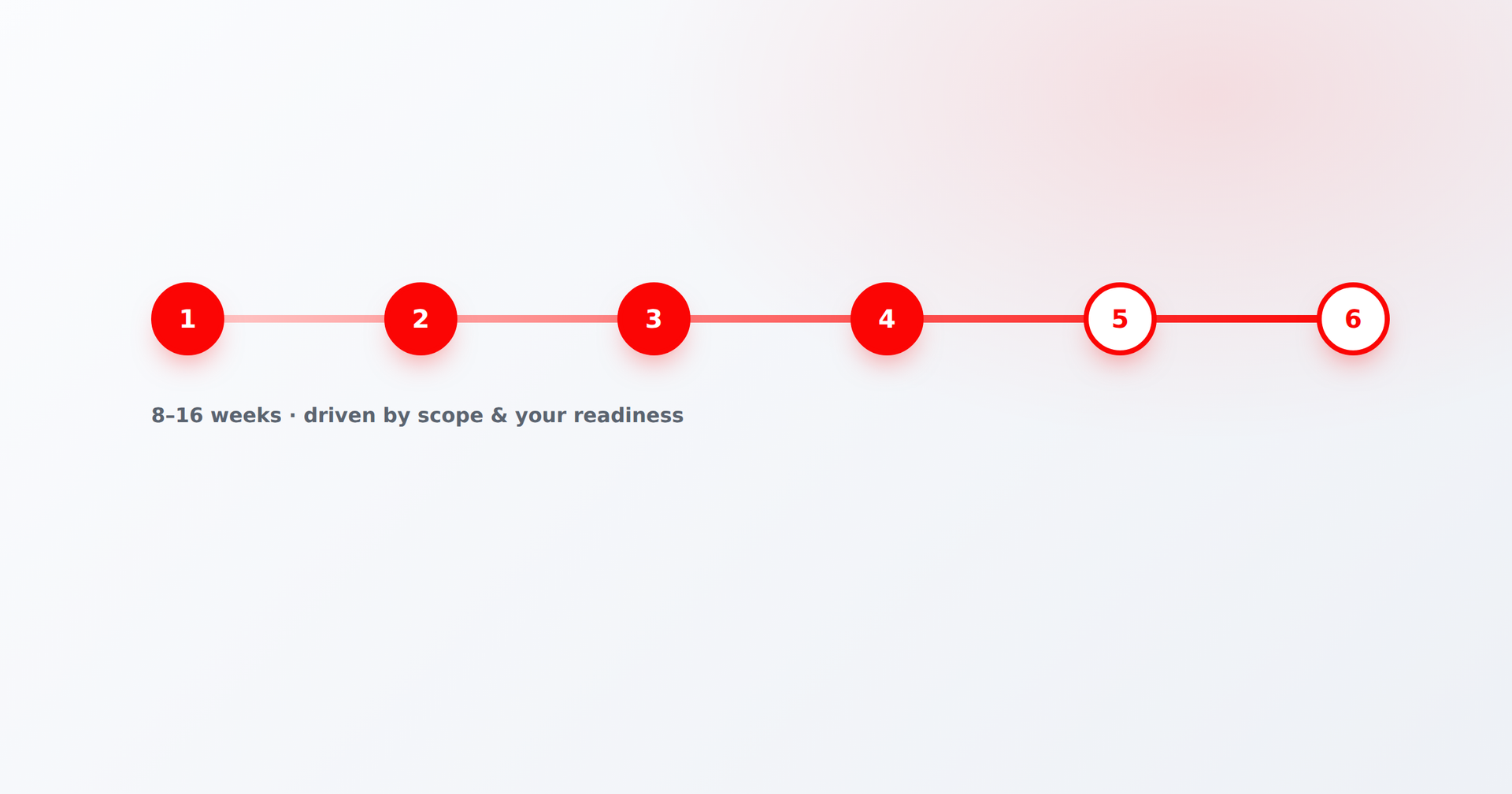
A Business Central implementation typically takes 8 to 16 weeks for a UK SMB, and the single biggest factor in whether it lands on time is not your partner — it's how prepared you are. We've done dozens of these, and the projects that go smoothly share one trait: an engaged internal owner who could answer "how does your business actually work?" without three follow-up meetings. This guide walks through the real phases, the decisions that matter, the pitfalls we see repeatedly, and how to get yourself ready.
The phases, honestly
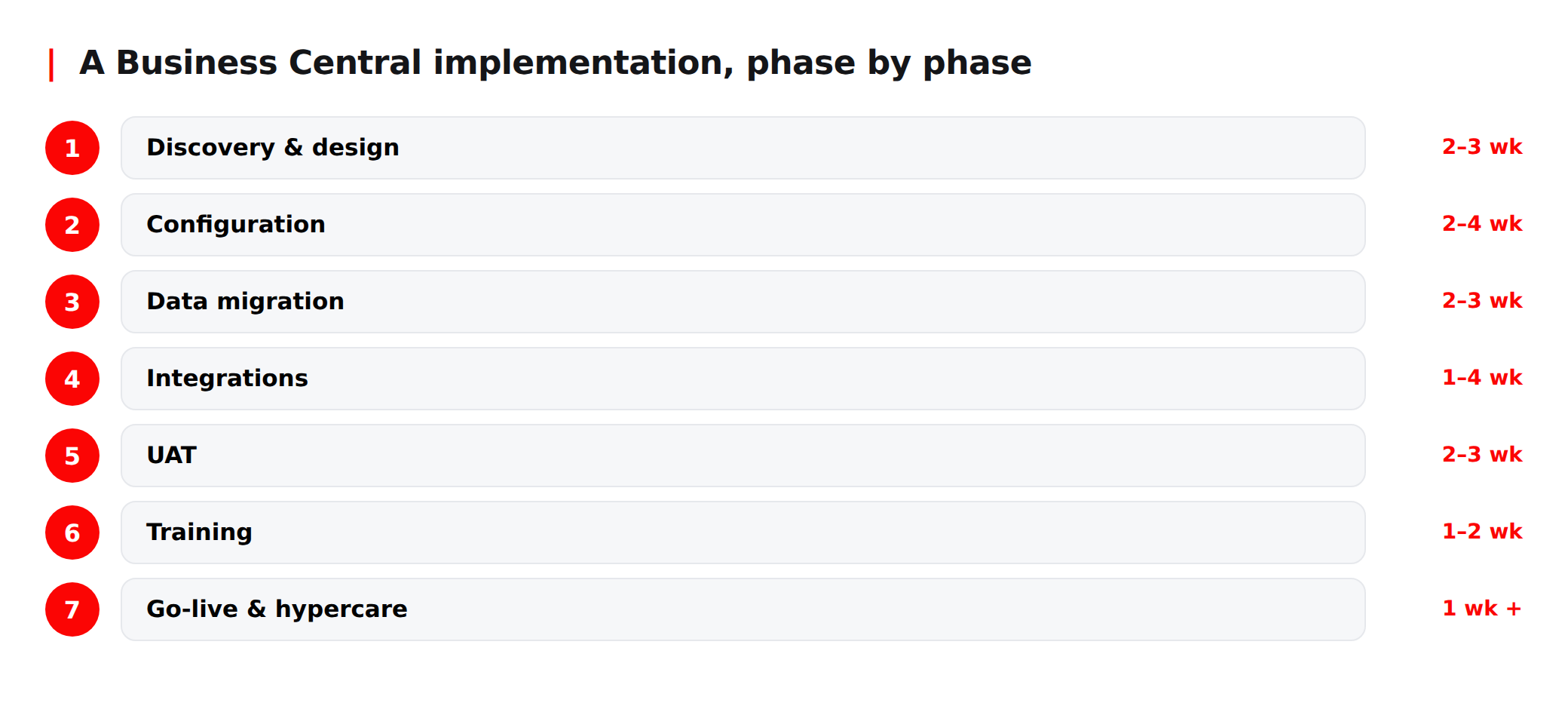
A well-run implementation moves through seven stages. They overlap in practice, but the sequence is fixed for good reason — you cannot configure what you haven't designed, and you cannot migrate into a chart of accounts that doesn't exist yet.
| Phase | Typical duration | What actually happens |
|---|---|---|
| Discovery & design | 2–3 weeks | Process workshops, chart of accounts + dimensions design, integration scoping, sign-off on a design document |
| Configuration | 2–4 weeks | Company setup, posting groups, number series, approvals, permissions built in a sandbox |
| Data migration | 2–3 weeks | Master data cleanse + load, then open balances (customers, suppliers, GL, inventory, fixed assets) |
| Integrations | 1–4 weeks | Connecting bank feeds, payroll, e-commerce, EDI, or a CRM — runs in parallel where possible |
| UAT | 2–3 weeks | You test real scenarios end-to-end against a scripted plan and sign off |
| Training | 1–2 weeks | Role-based sessions, not a single firehose demo |
| Go-live & hypercare | 1 week + 2–4 weeks support | Cutover, first postings, month-end, close hand-holding |
The range is wide because scope drives it. A single-company Essentials rollout with clean data and no integrations sits at the 8-week end. Multi-entity, Premium with manufacturing, three integrations and a messy legacy system pushes you to 16 weeks or beyond.
The decisions that matter most
Most of a Business Central implementation is quietly reversible. A few things are not, and getting them wrong means living with the consequences for years.
Chart of accounts and dimensions
This is the one to get right. Come from an older system and you'll be tempted to recreate your existing 400-line chart of accounts with departments and cost centres baked into the account numbers. Don't. In BC, dimensions do that job — Department, Project, Region, whatever you analyse by. Keep the GL lean and let dimensions carry the analysis. Redesign this properly and your reporting gets dramatically simpler; skip it and you'll be rebuilding reports 18 months later.
Posting groups
General business, general product, VAT, customer and vendor posting groups decide which GL accounts your transactions hit. They're unglamorous and they're where postings quietly go wrong. Design them deliberately during configuration, test them in UAT, and document the logic.
Approvals
Purchase and payment approval workflows are easy to over-engineer. Start with the approvals you genuinely need for financial control, not every theoretical one. You can add more later; unpicking an approval chain that's throttling the business is harder.
Common pitfalls
- Dirty data. Duplicate customers, dead suppliers, stock with no cost. Migration exposes every sin in your old system. Cleanse before you migrate, not during.
- Open balances that don't reconcile. Your migrated trial balance must tie to your last set of accounts to the penny. Budget time for this — it's the most common cause of a delayed go-live.
- UAT as a formality. Teams that click through a demo and sign off find the problems in week one of live running. Test real transactions: a full purchase-to-pay, a month-end, a VAT return.
- No internal owner. Covered below, because it's the big one.
- Scope creep dressed as "quick wins." Every mid-project customisation request pushes the date. Park them for phase two.
For the mechanics of moving your data across, our practical guide to Business Central migration goes deeper than we can here.
How to prepare as the customer
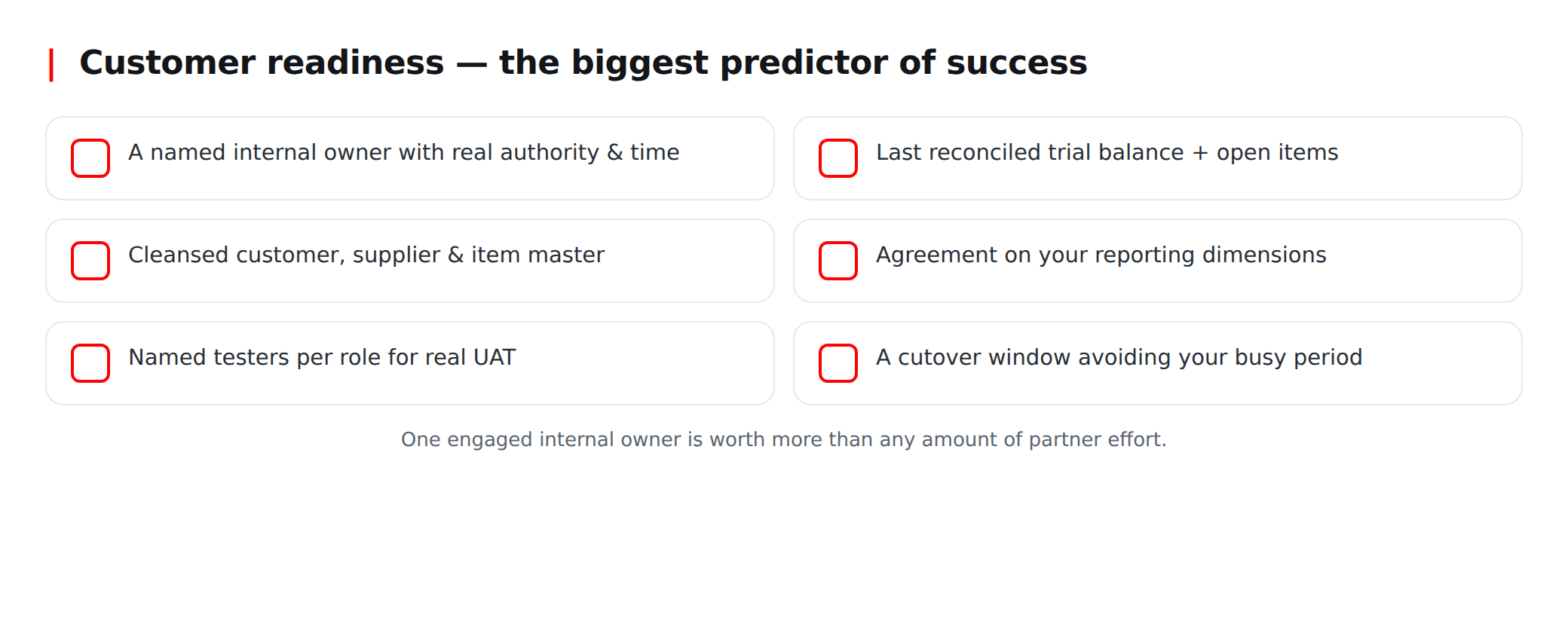
Here's the honest bit that isn't in most partner pitches: a good implementation is mostly about your preparation, not ours. The partner brings the platform expertise; only you know how your business runs. Use this readiness checklist before you start.
| Ready? | What we need from you |
|---|---|
| ☐ | A named internal project owner with real authority and time freed up |
| ☐ | Your last reconciled trial balance and open item listings |
| ☐ | A cleansed customer, supplier and item master |
| ☐ | Agreement on how you want to analyse the business (your dimensions) |
| ☐ | Named testers per role who'll actually do UAT |
| ☐ | A realistic cutover window that avoids your busiest period |
The internal owner is non-negotiable. Projects without one drift, because every design decision waits on someone who's "too busy this week." One engaged owner is worth more than any amount of partner effort.
When you should slow down — or not start yet
Against our own commercial interest: sometimes the right advice is don't start. We'd rather delay a project than deliver a bad go-live you'll resent.
- You're mid year-end. Going live weeks before or during your financial year-end splits your finance team's attention exactly when they can't spare it. Go live at the start of a period, ideally a new financial year.
- Your data is a mess and nobody owns cleaning it. If nobody has time to cleanse the master data, the project will stall in migration regardless of how good the partner is.
- There's no internal owner. If you can't free someone up to lead it from your side, wait until you can. This single factor predicts success better than anything else.
None of these are permanent blocks. They're reasons to spend four weeks preparing so the implementation itself goes cleanly.
Frequently asked questions
How long does a Business Central implementation take?
Typically 8–16 weeks. Clean data, a single company, Essentials and no integrations lands near 8. Multiple entities, Premium, integrations and legacy data cleansing push towards 16 or more. Timeline is driven by scope and your readiness, not by how fast anyone types.
What data actually comes across?
Master data (customers, suppliers, items, chart of accounts, fixed assets) and open balances — outstanding customer and supplier invoices, GL opening balances, stock quantities and values. We generally don't migrate full transactional history; it's expensive, rarely reconciles cleanly, and your old system stays available for lookups. Keep 12–24 months of the old system read-only instead.
Essentials or Premium?
Essentials covers finance, sales, purchasing, inventory and projects — right for most UK service and distribution businesses. Premium adds manufacturing and service management. If you don't make things or run field service, Essentials is almost certainly enough. You can upgrade later, so don't pay for Premium "just in case."
What makes an implementation go wrong?
In order: no internal owner, dirty data migrated without cleansing, open balances that don't reconcile, UAT treated as a rubber stamp, and going live at year-end. Notice that four of the five are on the customer side — which is exactly why preparation matters more than partner choice.
Ready to talk it through?
If you're planning a Business Central rollout and want a straight assessment of whether you're ready — and how long it'll realistically take — we're happy to walk through it. Talk to our team.