
Sage to Business Central: What UK Businesses Need to Know
A straight Sage to Business Central guide for UK businesses: when to move, what it costs, realistic timelines, and when you are better off staying put.

The honest short version: most UK businesses on Sage 50 or Sage 200 do not need to move, and the ones who genuinely benefit from Sage to Business Central usually share three traits — they have outgrown single-entity accounting, they are stitching together spreadsheets and add-ons to do things the ledger should do natively, and they want one system across finance, sales, stock and operations. If that is you, expect an 8–16 week project, a real cost, and a few months of adjustment. If it is not you, a Sage upgrade or a well-chosen add-on is often the smarter money. This guide walks the trade-offs both ways.
Signs you have outgrown Sage
Sage 50 and Sage 200 are good products. The problem is rarely the software itself — it is the shape of the business straining against it. Practical thresholds we see repeatedly:
- Multi-entity or multi-currency consolidation done in Excel every month-end because Sage 50 will not do it cleanly.
- Transaction volume climbing past roughly 5,000–10,000 lines a month, where Sage 50 starts to feel heavy and audit trails get unwieldy.
- Stock and manufacturing needs beyond basic — assemblies, multiple locations, proper landed costs, warehouse workflows.
- Users beyond 8–10 all needing concurrent access, granular permissions and remote working without a Remote Desktop workaround.
- Reporting that lives in exported spreadsheets because you cannot get the cut you need from the system.
- Integrations — you want the CRM, the e-commerce platform and the finance ledger to talk to each other without manual re-keying.
One or two of these? Look at Sage 200 or an add-on first. Four or more, and you are paying the "spreadsheet tax" — the hidden hours your finance team spends compensating for the system. That is usually where BC pays back.
What BC gives you that Sage does not
- One platform, natively integrated. Finance, sales, purchasing, inventory, projects and light manufacturing in one data model, with Power BI and the rest of Microsoft 365 (Outlook, Excel, Teams, Power Automate) sitting on top.
- Dimensions instead of a bloated nominal. Rather than exploding your chart of accounts, you tag every transaction with dimensions (department, project, region) and slice reporting any way you like. This is genuinely better than Sage's nominal structure.
- Multi-entity and intercompany handled properly, including consolidation.
- Extensibility and scale. A real API layer, AppSource extensions, and headroom to grow without re-platforming again in three years.
- Continuous cloud updates — two major releases a year, no version stranded on an old install.
What Sage still does better — genuinely
This is where most vendor guides go quiet. They should not.
- Simplicity and speed to competence. Sage 50 is quicker to learn and quicker to just do the bookkeeping. For a small team, BC is more system than you need, and that is a cost.
- Price at the small end. For a handful of users doing straightforward UK accounting, Sage is cheaper — often materially so once you count BC licences plus a partner.
- Payroll. Sage has mature, well-loved UK payroll. BC does not do payroll natively; you integrate a third party. If payroll is central to you, that is a real point in Sage's favour.
- The known quantity. Your team knows it, your accountant knows it, it works. "It works and everyone understands it" is worth money.
If you are a stable 5-person business with clean books and no growth complexity, moving to BC to "modernise" is usually the wrong call. Spend the money on Sage 200 or better reporting instead.
What the migration actually involves
The single biggest misconception: you are not lifting-and-shifting your whole Sage database. You migrate a clean opening position, not a decade of history.
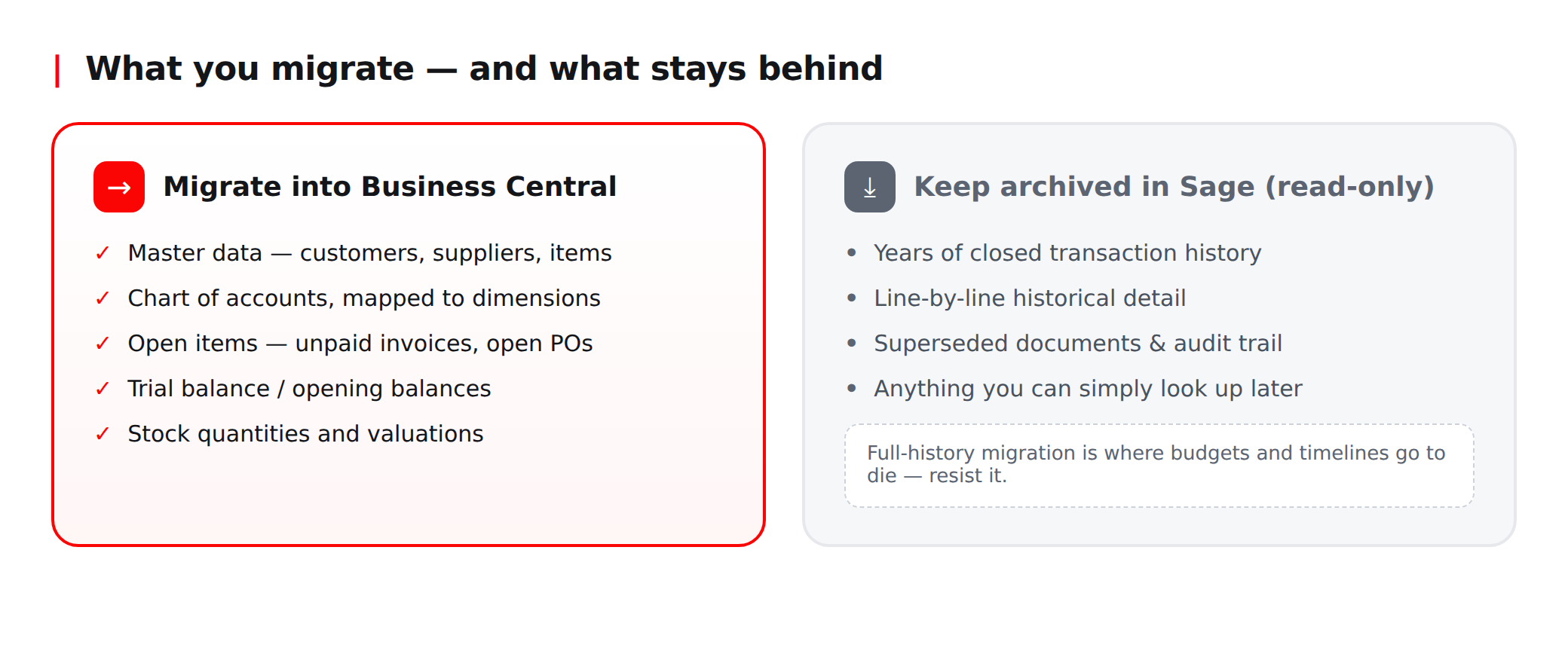
- Data — open balances, not full history. You bring master data (customers, suppliers, items, chart of accounts) and open items (outstanding invoices, open POs, stock quantities, trial balance). Closed transaction history stays in Sage, which you keep read-only for a couple of years. Trying to migrate full line-level history is where budgets and timelines go to die — resist it.
- Configuration. Posting groups, VAT (including MTD and reverse charge), dimensions, number series, approval workflows, user permissions. This is the real work and where a good partner earns their fee.
- Integrations. CRM, e-commerce, payroll, expense tools, bank feeds, Power BI. Each connector is scoped separately.
- People and adoption. The part everyone underestimates. Process change, training, a parallel-run or cutover plan, and a nominated internal champion. Software rarely fails on technology; it fails on adoption.
The mechanics mirror other cloud accounting moves. If you want the granular data-mapping detail, our Xero to Business Central migration guide covers the open-balance approach step by step — the principles are identical from Sage.
Realistic timeline and what drives cost
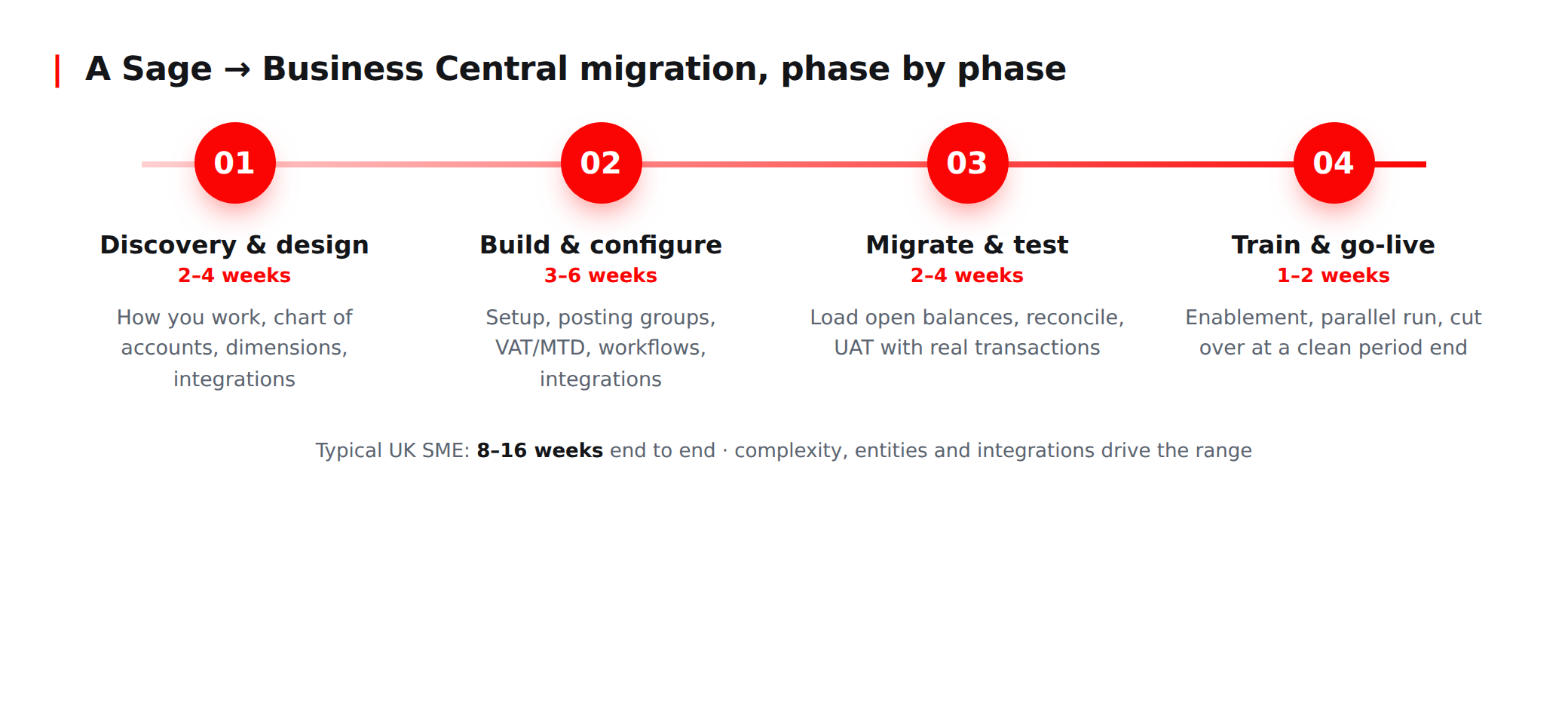
A typical Sage 50 or 200 move runs 8–16 weeks from kick-off to go-live. What moves you along that range:
| Driver | Faster (8 wk) | Slower (16 wk+) |
|---|---|---|
| Entities | Single company | Multi-entity, intercompany |
| Integrations | Bank feed only | CRM, e-commerce, payroll, bespoke |
| Customisation | Standard BC | Extensions / custom AL |
| Data | Clean masters | Messy, deduping needed |
| Users | Under 10 | 25+, multiple departments |
| Availability | Dedicated internal lead | Finance team already stretched |
Cost is driven by the same factors plus licences (BC Essentials vs Premium, per named user per month) and partner implementation days. As a planning figure, a straightforward single-entity implementation starts in the low five figures; complex multi-entity with integrations runs well beyond that. Be wary of any quote that has not asked about your integrations and entities — it is a guess.
Common pitfalls
- Over-migrating history. Costs more, delays go-live, adds risk. Keep Sage archived instead.
- Recreating Sage in BC. Bending BC to mimic old habits throws away the reason you moved. Adopt standard process where you sensibly can.
- Under-scoping payroll. Decide early: integrate, or keep Sage Payroll standalone.
- No internal champion. If nobody owns it inside the business, adoption stalls.
- Cutting over at year-end with no parallel run. Give yourself a fallback month.
When you should NOT move yet
Do not start if any of these are true:
- You are mid-year-end or in a heavy audit — wait for quiet water.
- Your Sage data is a mess. Fix the data on Sage first; migrating chaos just relocates it.
- You have no internal owner with time to give. A project with no champion will drift and cost more.
- Your only driver is "it feels old." That is not a business case.
- A single Sage add-on or a step up to Sage 200 solves the actual problem for a fraction of the cost. Sometimes it does — and we will tell you when it does.
Frequently asked questions
How much does moving from Sage to Business Central really cost?
Two parts: BC licences (per named user per month, Essentials or the pricier Premium if you need manufacturing or service management) and a one-off implementation. A clean single-entity project typically starts in the low five figures; multi-entity work with several integrations is a multiple of that. The honest answer is that anyone quoting before asking about your entities and integrations is guessing.
Can I keep all my Sage transaction history?
You keep it — in Sage, archived and read-only. You migrate open balances and master data into BC, not years of line-level detail. That is deliberate: full-history migration inflates cost and risk for information you can still look up in the old system. For statutory purposes, keeping Sage accessible for a few years is standard practice.
How long will my team be disrupted?
Expect a dip. The go-live week and the first month-end in a new system are the hard part; plan lighter workloads and support around them. With training and a parallel run, most finance teams are comfortable within one to two full cycles. The disruption is real but bounded — and far smaller than the ongoing drag of a system you have outgrown.
Is now the right time, or should we wait?
Wait if you are in year-end, mid-audit, short of an internal owner, or your Sage data needs cleaning first. Move when you have a genuine business case, a nominated champion and a quiet quarter ahead. Timing badly is one of the few ways to turn a sound project into a painful one.
Ready to talk it through?
If you are weighing Sage to Business Central and want a straight answer on whether it is worth it for your business — including an honest "not yet" if that is the truth — we are happy to talk. We would rather point you to the right Sage upgrade than sell you a migration you do not need. Take a look at what we do or talk to our team for a no-pressure scoping conversation.