
Business Central Pricing UK: What You Will Actually Pay in 2026
If you have searched for Business Central pricing UK, you have almost certainly landed on a page that tells you to contact a partner for a quote. This article does not do that. Instead, it breaks down what you can expect to pay in 2026 — licence costs, implementation costs, and the total cost of ownership over a realistic time horizon — so that you can walk into any conversation with a Microsoft partner knowing the numbers.
The headline answer: for a UK business with 10 to 25 users, an all-in budget of between £30,000 and £80,000 for year one is realistic. Beyond year one, you are primarily paying for licences and support. The range is wide because implementation scope varies considerably. This article explains what drives the difference.
Business Central Pricing UK: The Three Licence Tiers
Microsoft publishes three user licence types for Business Central.
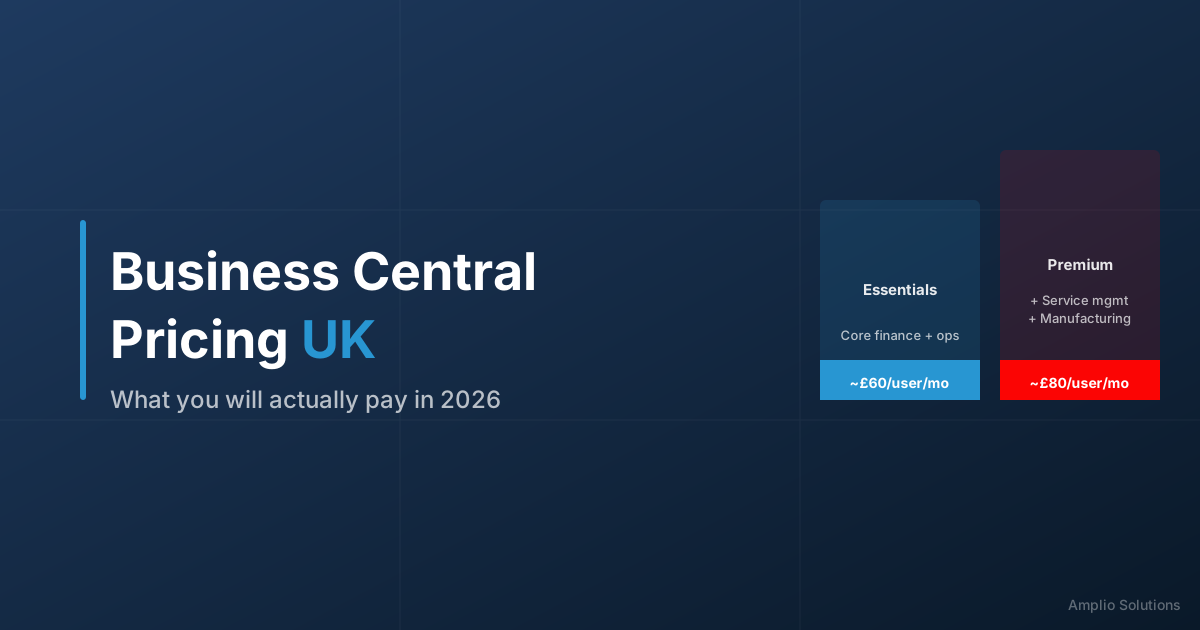
Essentials. The core licence, covering finance, purchasing, sales, inventory, manufacturing, and project management. This is the right licence for most users in a UK SMB that is not running a separate service management module through Business Central. Microsoft's published UK MSRP for Essentials runs in the region of £55 to £65 per user per month, depending on agreement type and exchange rate applied at billing.
Premium. Adds Service Management — field service, service orders, service contracts — and a deeper Manufacturing module including production orders, capacity planning, and machine centres. Most UK SMBs that are not running a field service or complex production operation do not need Premium. The additional cost is rarely justified if those modules will sit unused. Premium typically runs £15 to £25 more per user per month than Essentials.
Team Member. A restricted licence for users who need read access to most data and limited write access to a small number of defined areas — expenses, absence, basic task completion. At around £6 to £8 per user per month, Team Member is useful when your headcount is high but most staff only need to approve, view, or record simple transactions. It is not a substitute for a full licence for finance, purchasing, or operations staff.
Microsoft resells these licences through partners under a Cloud Solution Provider agreement. In practice, your price per user per month may be slightly above or below the published MSRP depending on your partner's structure and the currency rate applied. The MSRP is the right anchor for budgeting; the final number is usually within five to ten percent of that.
What the Licence Does Not Include
The licence covers access to Business Central and the right to use the core functionality described above. It does not cover:
- Implementation — the work of setting up, configuring, and migrating your data to go live
- Customisations or extensions — any development beyond standard functionality
- Third-party add-on solutions for specialist reporting or document management
- Annual support and managed service after go-live
These are the costs that make the total price of Business Central vary so significantly between businesses. A business that implements standard Business Central with minimal customisation and clean data will pay considerably less than a business with complex multi-entity structures, legacy data in a non-standard format, and significant integration requirements.
What Implementation Typically Costs for UK SMBs
Implementation is priced by the number of days of professional services required to deliver the project. Most Microsoft partners in the UK charge between £850 and £1,500 per day depending on the consultant's seniority and the partner's overhead structure. Day rates in London and the South East tend to run higher than in the Midlands and the North.
For a straightforward Business Central implementation — finance, purchasing, sales, and stock management for a single UK legal entity with clean data and a team of 10 to 25 users — a realistic delivery is 20 to 40 days of consultant time. That equates to a professional services investment of between £17,000 and £60,000.
That range narrows considerably once you define the following:
- Number of legal entities. Each additional entity adds data migration, configuration, and inter-company setup work. A two-entity implementation may take 30 to 50 percent longer than a single-entity one of the same operational complexity.
- Data migration complexity. A business with clean, well-structured data in a single accounting system migrates faster than one whose records are spread across spreadsheets, legacy systems, and paper files.
- Customisation requirements. Standard Business Central covers most operational needs for a typical UK SMB. Every customisation adds development time, testing time, and ongoing maintenance cost.
- Integrations. Connecting Business Central to an ecommerce platform, a payroll system, or a logistics tool introduces API work, mapping, and testing that adds days to a project.
A UK Example: What 15 Users Actually Paid Over Year One
A Midlands-based professional services firm with 15 Business Central users and two UK legal entities — a trading company and a property holding company — went through an implementation with clean data from a single prior accounting system and no significant customisation requirements. They needed finance, purchasing, project management, and a basic inter-company elimination journal.
Their total year-one cost broke down as follows:
- Essentials licences — 15 users × £60/month × 12 months: £10,800
- Implementation — 28 days × £1,100/day: £30,800
- Annual support (post-go-live managed service): £6,000
- Total year one: £47,600
From year two, their ongoing cost was approximately £16,800 per year in licences and support. Over a five-year horizon, the total cost of ownership was approximately £114,000. Spread across 15 users over five years, that comes to around £1,520 per user per year — or just over £126 per user per month when everything is included.
That is the number that puts the licence price in context. The licence itself is not the largest line item in year one. Implementation is.
The Fixed-Price Route for UK SMBs
One of the recurring frustrations for businesses evaluating Business Central is the absence of published prices. Quotes take weeks, projects take months to scope, and the cost is not confirmed until a statement of work has been agreed and signed.
Amplio's FastBC package is a fixed-price, fixed-scope Business Central implementation designed to give UK SMBs a predictable starting point. The package covers finance essentials, core purchasing, sales, and stock management for a single UK legal entity, implemented over a defined timeline with a published price — so there are no open-ended professional services commitments at the outset.
FastBC is not the right fit for every business. A business with complex multi-entity structures, significant data migration challenges, or bespoke workflow requirements will need a scoped project rather than a packaged approach. But for a business moving from spreadsheets or a single accounting package to Business Central for the first time, it is the most direct route from decision to go-live with a confirmed total cost.
Business Central Pricing UK: Getting a Number That Is Specific to You
The price for Business Central is a combination of your licence mix, your implementation scope, and your ongoing support arrangement. There is no single correct answer, but there is a clear process for arriving at one.
Establish your licence count: how many full users, how many restricted users, and which tier each group needs. Scope your implementation: how many legal entities, how complex is your data, what integrations are required, and what is standard versus what needs to be built. Agree your post-go-live support model: do you want a partner to handle ongoing changes and support, or will you manage internally?
With those three pieces of information defined, a credible estimate should take a short initial conversation — not a multi-week discovery exercise.
If you are at the point of wanting a fixed price rather than a range, the next step is a structured scoping call with Amplio. We work through the licence question, the implementation scope, and the delivery approach, and we give you a clear number to take to your board — with no obligation to proceed.